Independence
—
translation: Louis Shurmer-Smith
published on April 25, 2008
(2008)
In Africa and parts of Asia, the colonial period generally lasted only a century, sometimes less. In the Caribbean, it would extend over three, indeed four centuries.
Today there are some 13 independent states in the Archipelago alone (36 million population and 235 000 km²) as against 12 for the whole of South America. To these should be added around 10 non-sovereign continental, and several island, territories.
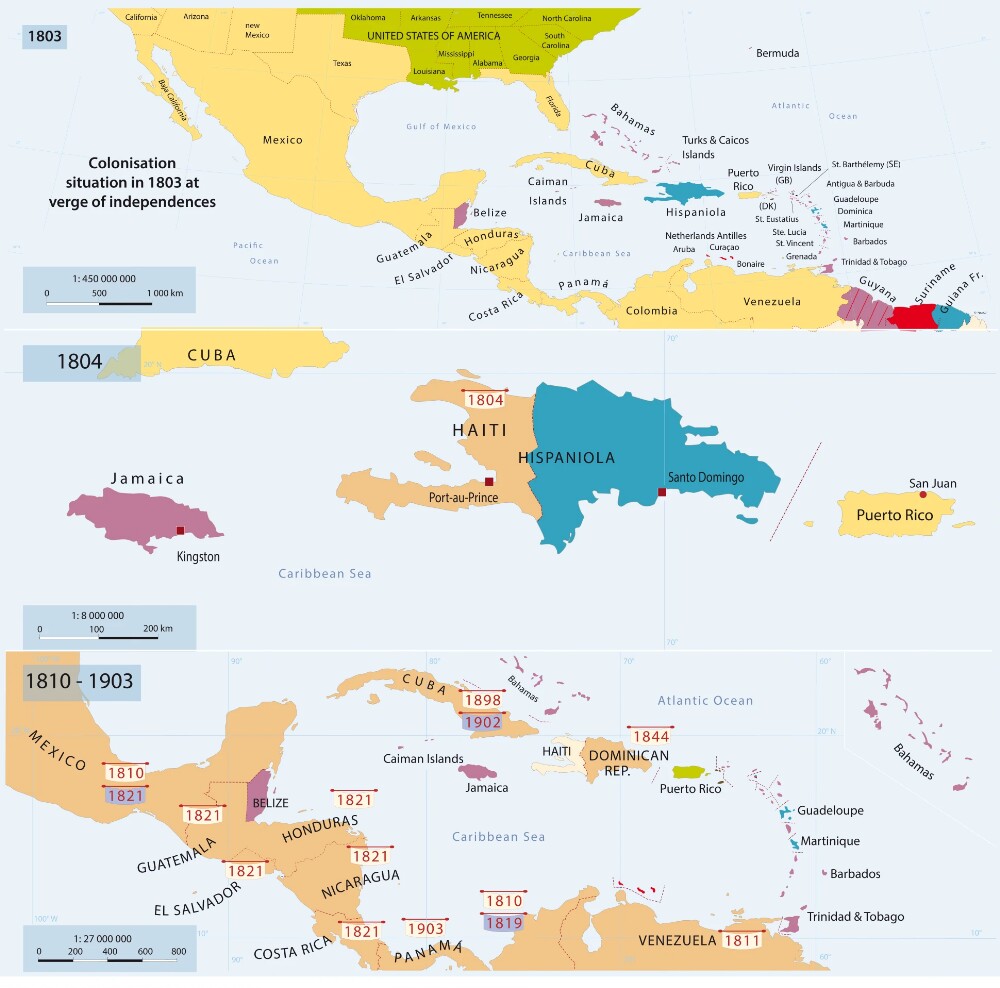
At the end of the 18 th century came the first wave of decolonization, starting in North America, fanned by the French revolution, and spreading rapidly to Haiti. From the 1 st January 1804, the Haitian revolution proved unique of its kind in bringing to an end at the same moment of time, the colonial system and the slave trade, and giving birth to the first black republic. Enveloping then isthmic meso-America and the South of the continent, which the Creole elites would liberate from Spanish tutelage from 1832 onwards, there would however be no immediate follow-up in the rest of the Caribbean Archipelago where the colonial order would be later removed.
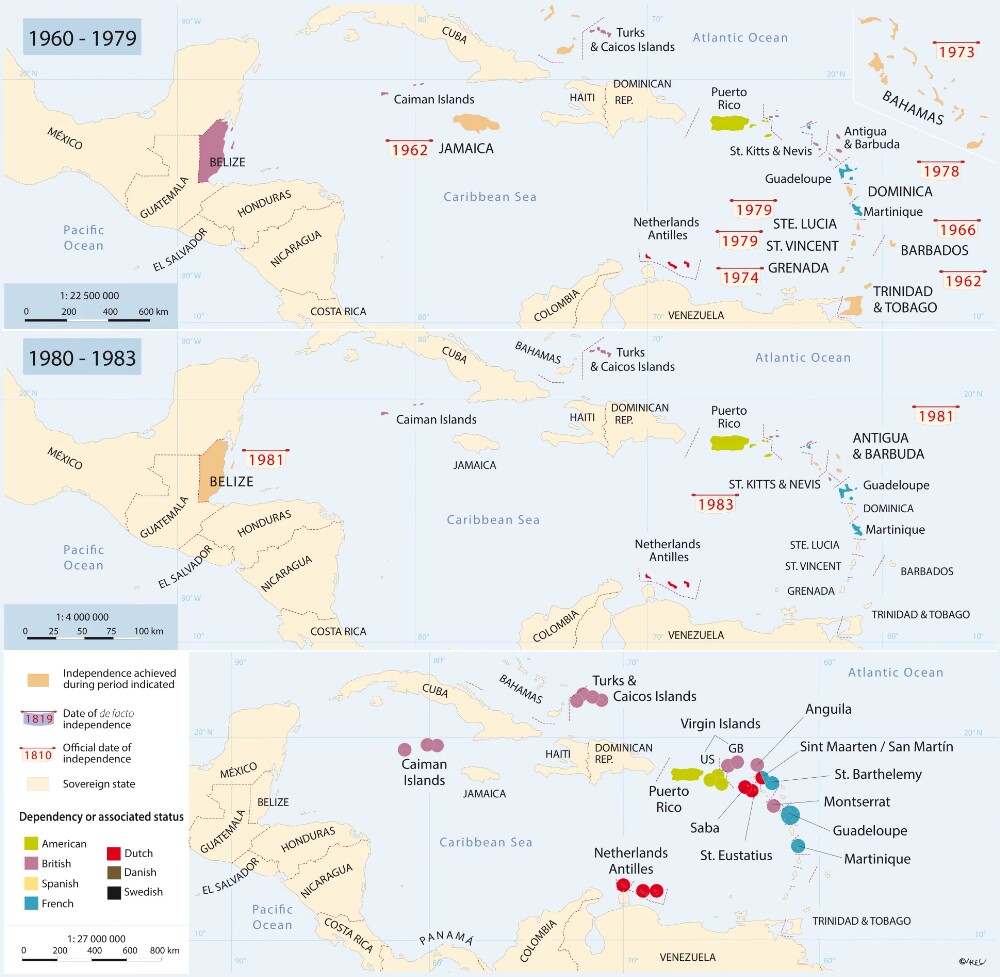
It was not until the end of the 19 th century that Santo Domingo, then Cuba in 1895-1901 acceded in turn to a purely theoretical freedom. Following the Second World War, 11 new island states would achieve independence, mostly in the British West Indies. Emancipation, peacefully negotiated, has proved slow in the Caribbean region. (Decolonization is all but complete in Asia and Africa.) Many would await the 1970s, and the ex-Dutch dependency of Aruba would only become independent in 1996.
In the absence of any regional ‘dynamic,' the specific context attached to each colonial empire determined the particular modalities of the process adopted, as in the case where colonies were grouped. Britain, for example, had been encouraging its Caribbean colonies to unite prior to independence, but the 'West Indian Federation' formed in 1958 soon woke up in 1962. 12 British colonies had become separate independent states by 1983. In contrast to this policy of general and gradual decolonization, preceded by an extended period of autonomy, the old French colonies of the Antilles and Guyana, integrally transformed into French ‘departments' in 1946, and Puerto Rico becoming an associated free state of the United States in 1952, in effect tightens their links with their respective colonial homelands. Several island groups like the Dutch West Indies, American Virgin Islands, as well as a few British islands, also remained under tutelage. Decolonization has therefore not been total, but the remaining non-sovereign territories in question count for only 5.1 million inhabitants, of which Puerto Rico accounts for 3.7 million.
Nourished by micro-particularisms , finely-tuned perceptions of identity, and acute sensibilities in respect of domination, the propensity towards statehood remains strong in the Archipelago. It corresponds to several scenarios: in the French departments, desire for independence expresses itself by a rejection of a situation deemed colonial, but the vague separatist impulses of Saint Martin are more directed against the Curacao government than that of the Netherlands. Finally, the territorial integrity of several pluri-insular states is threatened by secessionist movements: Nevis contests the hegemony of Saint Kitts, Tobago that of Trinidad, Barbuda that of Antigua. The political configuration of the region still has the potential to evolve further.
Table n°1: Dates of accession to independence
| Antigua and Barbuda | 01.11.1981 | El Salvador | 15.09.1821 | Panama | 03.11.1903 | ||
| Bahamas | 10.07.1973 | Grenada | 07.02.1974 |
Saint Kitts and Nevis
|
19.09.1983 | ||
| Barbados | 30.11.1966 | Guatemala | 15.09.1821 | Saint Lucia | 22.02.1979 | ||
| Belize | 21.09.1981 | Guyana | 28.05.1966 |
Saint Vincent and the Grenadines
|
27.10.1979 | ||
| Colombia | 20.07.1810 | Haiti | 01.01.1804 | Suriname | 25.11.1975 | ||
|
Costa Rica
|
15.09.1821 | Honduras | 15.09.1821 | Trinidad-et-Tobago | 31.08.1962 | ||
| Cuba | 10.12.1898 | Jamaica | 06.08.1962 | United States | 04.07.1776 | ||
| Dominica | 03.11.1979 | Mexico | 16.09.1810 | Venezuela | 05.07.1811 | ||
| Dominican Republic | 27.02.1844 | Nicaragua | 15.09.1821 |
Note []
To cite this document:
Bégot, M. & Buléon, P. (2008). Independence. Atlas Caraïbe.