Barbados
—
translation: Louis Shurmer-Smith
published on Sept. 23, 2011
(2011)
Indépendence: 30.11.1966
In 1536, the Portuguese explorer Pedro A. Campos chose to call this island 'Los Barbados' (the bearded) with reference to the long aerial roots of certain fig trees which resembled beards.
General information
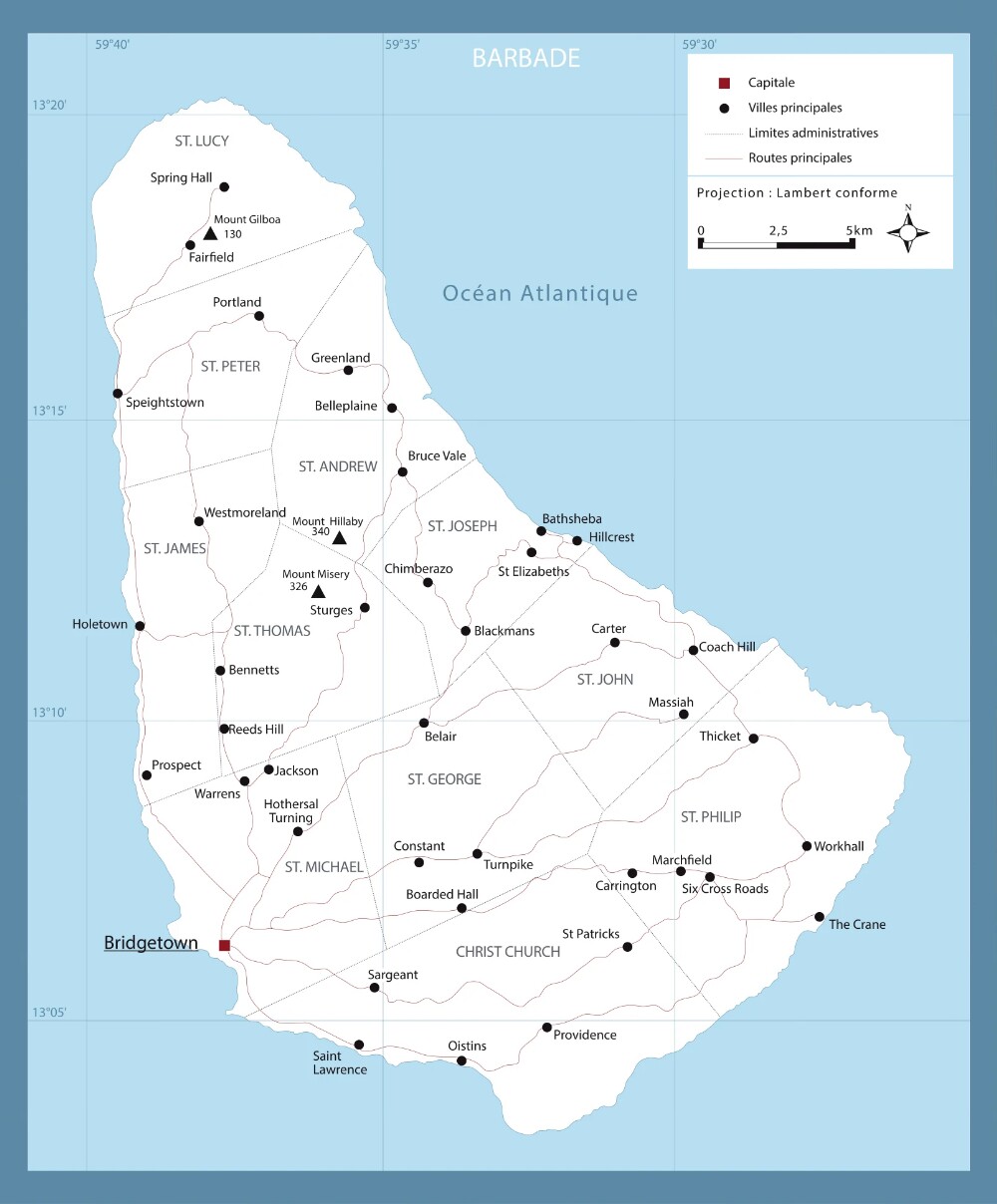
Area: An island of 431 sq. kms
Location: 13°N 59°W
Situated to the northeast of Trinidad, Barbados is the easternmost of the Windward Islands in the Lesser Antilles. Highest landmark: Mount Hillaby (336 m)
Capital: Bridgetown, the only seaport (a major part of the island is surrounded by coral reef).
Official language: english. Everyday languages: english, bajan (barbadian creole).
Currency: barbadian dollar (BBD) with a fixed exchange rate of 1 US$ = 2 BB$ since 1967, that is 1 € = 2.79 BB$ (October 2010).
Political regime : Constitution: Parliamentary monarchy
International and regional organisations:
-
Member of the UN (09.12.1966)
-
Member of the WTO (01.01.1995)
-
Member of the Commonwealth (1966)
-
Member of the GATT (1967)
-
Founder member of CARICOM (01.08.1973) and of ACS (24.07.1994)
Brief History
With its Amerindian population , the island was the first European berthing point in the Caribbean. Discovered by the Portuguese in 1536, colony of the United Kingdom from 1627 to its independence in 1966, Barbados became a crossroads between western Europe, the Caribbean islands and some regions of the South American continent.
Nicknamed 'Little England' by its neighbours, Barbados remains heavily marked by British influence in spite of the growth of regionalist feelings and cultural nationalism since independence.
Cultural particularities
National dish: 'coucou' (base of okra and maïze meal)
Personalities:
-
Ryan Brathwaite: world champion 2009, 110 m hurdles
-
Rihanna: singer R'n'B/Pop/ Reggae
-
Rosemary Philips: jazz singer.
Note []
To cite this document:
Verrecchia, M. (2011). Barbados. Atlas Caraïbe.