Puerto Rico
—
translation: Louis Shurmer-Smith
published on Jan. 27, 2012
(2012)
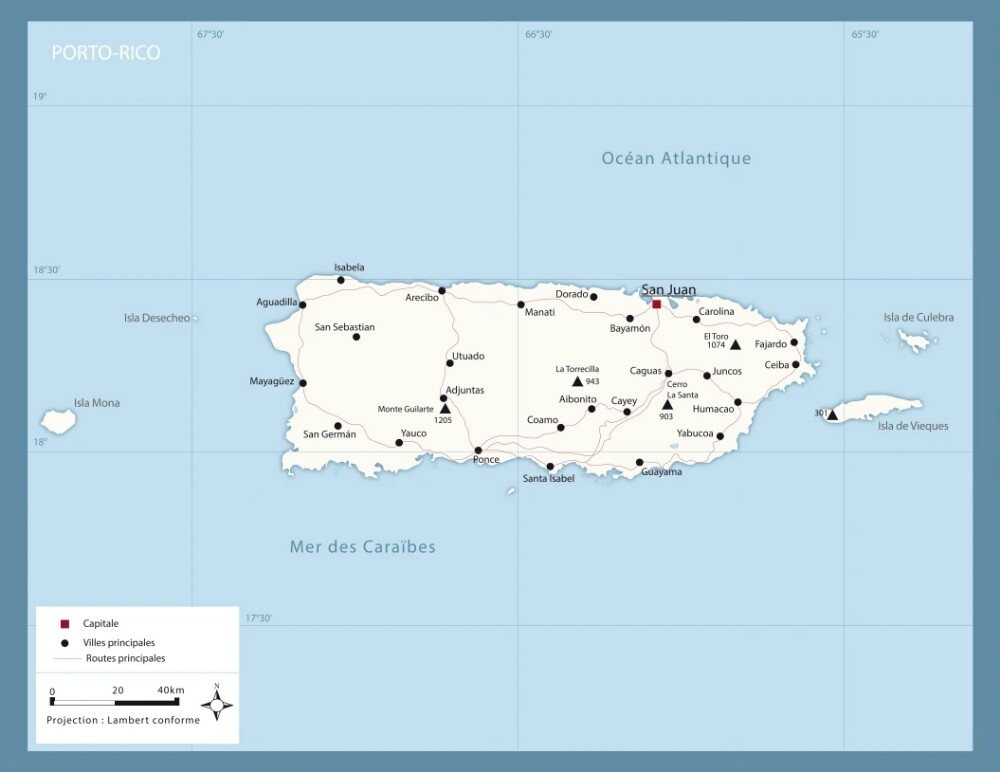
Puerto Rico
General information
Commonwealth of Puerto Rico associated territory of the United States. Puerto Rico was ceded to the USA after the Hispanic-American war. The Puerto Ricans were afforded American citizenship in 1917, and governors have been elected by popular mandate since 1948. At each of the plebiscites in 1967, 1993 and 1998, the population elected to remain within the Commonwealth.
Area: 9 104 km 2 (4 main islands: Purto Rico, Vieques, Isla Mona and Culebra)
Location: between 17°53'8" and 18°32'23" latitude north and 67°18' longitude west. Situated in the Greater Antilles to the East of the Dominican Republic and to the West of the Virgin Islands. Highest landmark: Cerro de Punta (1 339 m)
Capital: San Juan: 1 st ranked port of the Caribbean, 5 th ranked in the US, but confronted by saturation of its facilities and competition from neighbouring ports. Major airport hub of the Caribbean.
Official language: spanish and english. Everyday languages: spanish (used daily and in schools, spoken by 98% of the population)
Currency: US dollar
Type of State: Associated free state of the USA with the title 'Commonwealth' (with no obligations under the American federal fiscal system)
-
Head of State: Barak Obama (since 2009)
-
Head of Government: Luis Fortuño, since January 2009. He is also chairman of the Partido Nuevo Progresista (PNP), affiliated to the American Republican Party, and the first
-
Institutions: presently, Puerto Rico is officially a "Commonwaealth." This statute allows for the election of a representative to the American Congress (to the House of Representatives), but with no voting rights. Puerto Ricans are American citizens from birth, but the islanders have no voting rights in the election for the President. However, based on the US model, the island has both a local congress and senate.
Politics and independence:
The main political parties are:
PNP ( Partido Nuevo Progresista ): New Progressive Party largely dominates the two local chambers since the elections of November 2008, with 37 of the 51 seats in the Chamber of representatives and 22 of the 27 seats in the Senate. The PNP is the mouth piece of a policy of full and comprehensive integration within the United States as the 51 st state of the Union.
-
PPD ( Partido Popular Democratico ): Popular Democratic Party, supporter institutionally of the status quo, and affiliated to US Democratic Party..
-
PIP ( Partido Independentista Puertorriqueño ): Puerto Rican Independence Party is not represented in Parliament but supported by numerous international leaders, as well as the Colombian writer Gabriel Garcia Márquez, having campaigned in its favour.
International and regional organisations :
-
Not represented at the United Nations.
-
Caricom (Caribbean Community and Common market) (observer status)
-
ECLAC (member)
-
FAO (member)
-
ICFTU ( member )
-
Interpol
-
Committee .
-
WHO (member)
Brief History
Indian origins, Spanish colonisation, peopling from Africa... Puerto Rico shares a history rich in contact and exchange with its Cuban and Dominican neighbours. Even so, since the end of the 19 th century it is with in the shadow of the United States tat today it is now "associated" in developing its particular identity.
Up until the 15 th century, the peace-loving Tainos (originating from South America) occupy the whole of the island, living off its agricultural resources.
-
1493, marks the arrival of Christopher Columbus (19 November).
-
1508, beginnings of Spanish colonisation.
-
1898, Spain cedes the island at the Treaty of Paris.
-
1900, Puerto Rico officially becomes an American territory.
-
1952, Puerto Rico obtains the status of a free state associated with the Commonwealth .
-
1993, referendum on the island's future extends the constitutional status quo (even though 42% of the population vote in favour of annexation of the island by the United States) .
Some strong points
-
Economy owes much to US federal transfers: 20% of GDP. A fabourable fiscal situation and tax exem^pt access to US markets has helped to sustain strong investment on the part of American companies since 1950 . Traditionally, tourism is an important source of income (2.5 million tourists in 2009)
-
One of the cradles of Taino civilisation : numerous vestiges remains (Tibes: center of native ceremonies. DNA tests in 2003: 61% of the island population has indications of Taino blood.
-
Arecibo radio telescope (1974): largest in the world (300 m parabolic diameter).
-
Traditional activities: cock-fighting, "quinceanero."
-
Literature: largely produced by expatriates "Nuyoricains," dwelling around the identity and links between the aca (here) and the alla (over there).
Note []
To cite this document:
Verrecchia, M. (2012). Puerto Rico. Atlas Caraïbe.