Martinique
—
translation: Louis Shurmer-Smith
published on Oct. 17, 2011
(2011)
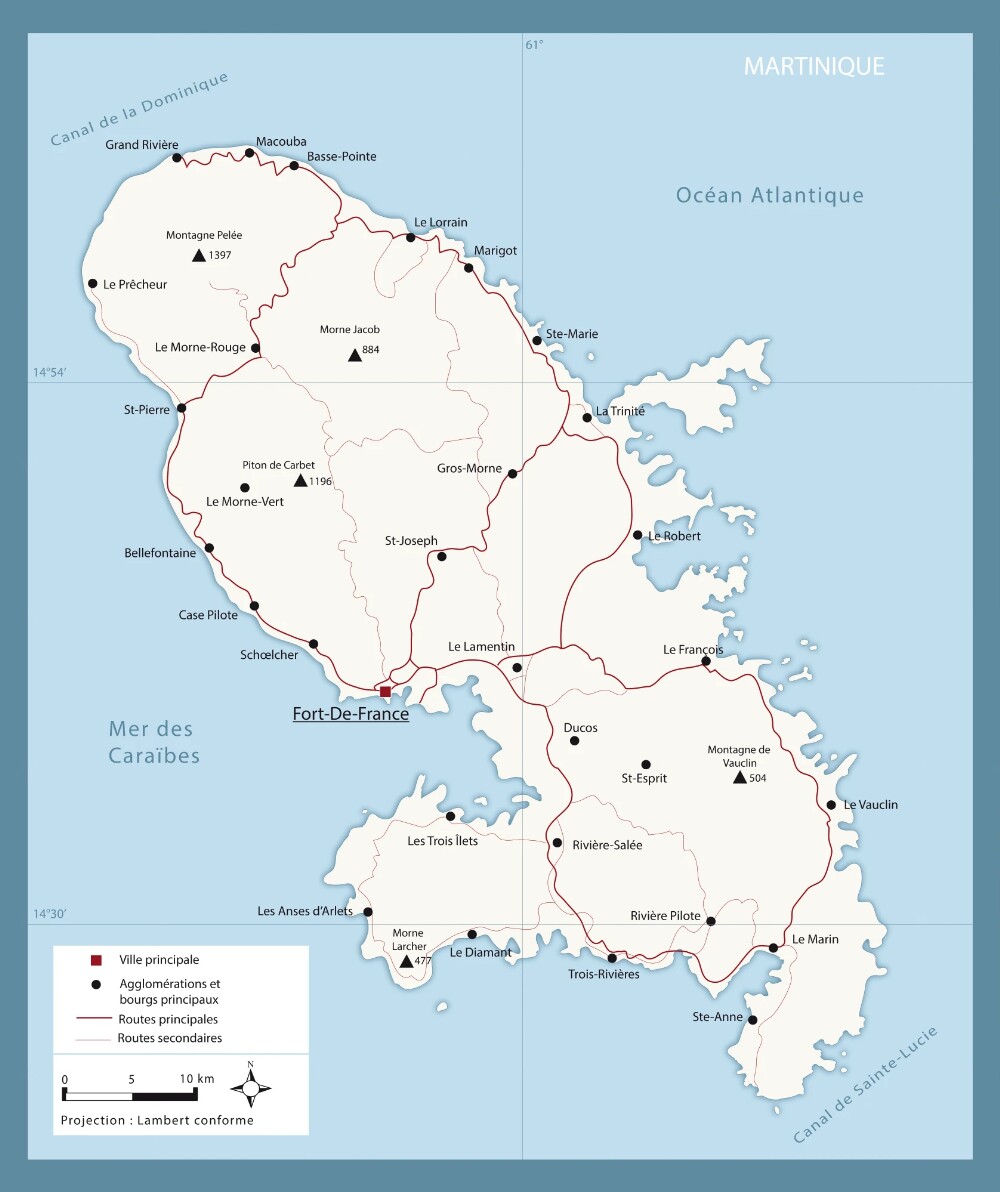
Martinique
General information
French department since 19.03.1946
Area : island covering 1 080 km 2 , 80 km long and 39 km wide
Location : 14°40'N 61°W. Situated to the South of Dominica (25 km) and to the North of Saint Lucia (37 km) and 120 km from Guadeloupe. Highest landmark : Mount Pelée (1 397 m)
'Chef-lieu' (principal place): Fort-de-France, main seaport.
Everyday languages : french, creole.
Currency : Euro
Brief History
In 1635 when the French colonised Martinique
, the island was populated by Amerindians, the Kalinagos . The name of the island comes from the Amerindian 'Martinino.' The wealth of the island developed from plantation agriculture (cacao, coffee, sugar cane) with a labour force made up of slaves originally from Africa. Slavery was abolished in 1848.
Today Martinique is both an overseas French region and department. It is part of the American French Departments in the same way as Guiana and Guadeloupe, and the Martinique region is also designated as one of the outermost region (OMR) of the European Union.
Political structure is identical to that of a French department. Latter is admiknistered by a general council, chaired by the departmental president Josette Manin. Since 1981: French region, administered by a regional council, under current president Serge Letchimy. Currently underway: establishment of a single collectivity, fusing the powers of the two previous assemblies (department and region).
Religion : majority Catholic. Other groups represented: Jehovah's Witness, Evangelical, Pentecostal, Seventh-day Adventist Church, Islamist, Jews, Hindous, Rastas, Voodoo.
Banana production represents a strong sector as regards exports
(180 000 tons) as well as agro-industrial products, with Martinique rum obtaining an AOC appellation in 1996.
Saint-Pierre was the economic capital of Martinique before its destruction in 1902, following a volcanic eruption. A burning hot ash-cloud destroyed the town referred to as the 'Little Paris of the Antilles.' today, it is listed as the hundredth and one of France's towns of 'Art and History' for the ruins of the theatre, the dungeon of Cyparis, one of the survivors, the church of the Fort, and the Figuier quarter.
Cultural particularities
22 mai: commemoration of the abolition of slavery
February-March (meat days): carnivall
Traditional sports activities: round Martinique yawl race
Traditions: cock-fighting; music: bèlè, biguin, mazurka, zouk.
National dish: creole dishes: accras (fritted struffed with vegetables or cod), "féroce" of avocado, stuffed crabs; grilled fish, "Blaff" of fish, "z'habitants" soup; "Blanc-manger" coconut. Drink: Ti'Punch: white rum, cane syrup, lime.
Personalities:
Aimé Césaire (1913–2008) poet, politician
Edouard Glissant (1928–2011), poet, writer
Patrick Chamoiseau, Goncourt prize, 1992.
Note []
To cite this document:
Richer, Y. (2011). Martinique. Atlas Caraïbe.